Do lawyers need a website if clients come from referrals?
The referral gets your name. The search decides whether they call.

By Gaston Sitbon, co-founder of SettledSites
Published · Last reviewed
Short answer: No, you don't need a website at all. But if you want a presence online that you own and control, then yes. An Avvo or LinkedIn profile is nice, but it doesn't belong to you. And your referrals will look you up: in one survey, only 1 in 10 people who got a lawyer recommendation didn't research or contact that lawyer, and nearly half checked the lawyer's reputation online.
"All my work comes from referrals" is the most common reason lawyers give us for not needing a website. It's a fair point, and for some lawyers it's true. Here's what happens after a friend passes your name along, and when a site really matters.
Why does a referred client still look you up?
Have you ever been reading a book about a person or an event and stopped to look up the person who wrote it, or the person it's about? I have. And plenty of other people do too.
We have a need to see who we're thinking about. And when we have to trust someone to fix a problem for us, that need gets even stronger. People want to read about you, see what you have to say, get a feel for how you present yourself, and check anything else they're curious about.
The numbers say the same thing.
9 in 10people who got a lawyer recommendation researched or contacted that lawyerMartindale-Avvo, 2023
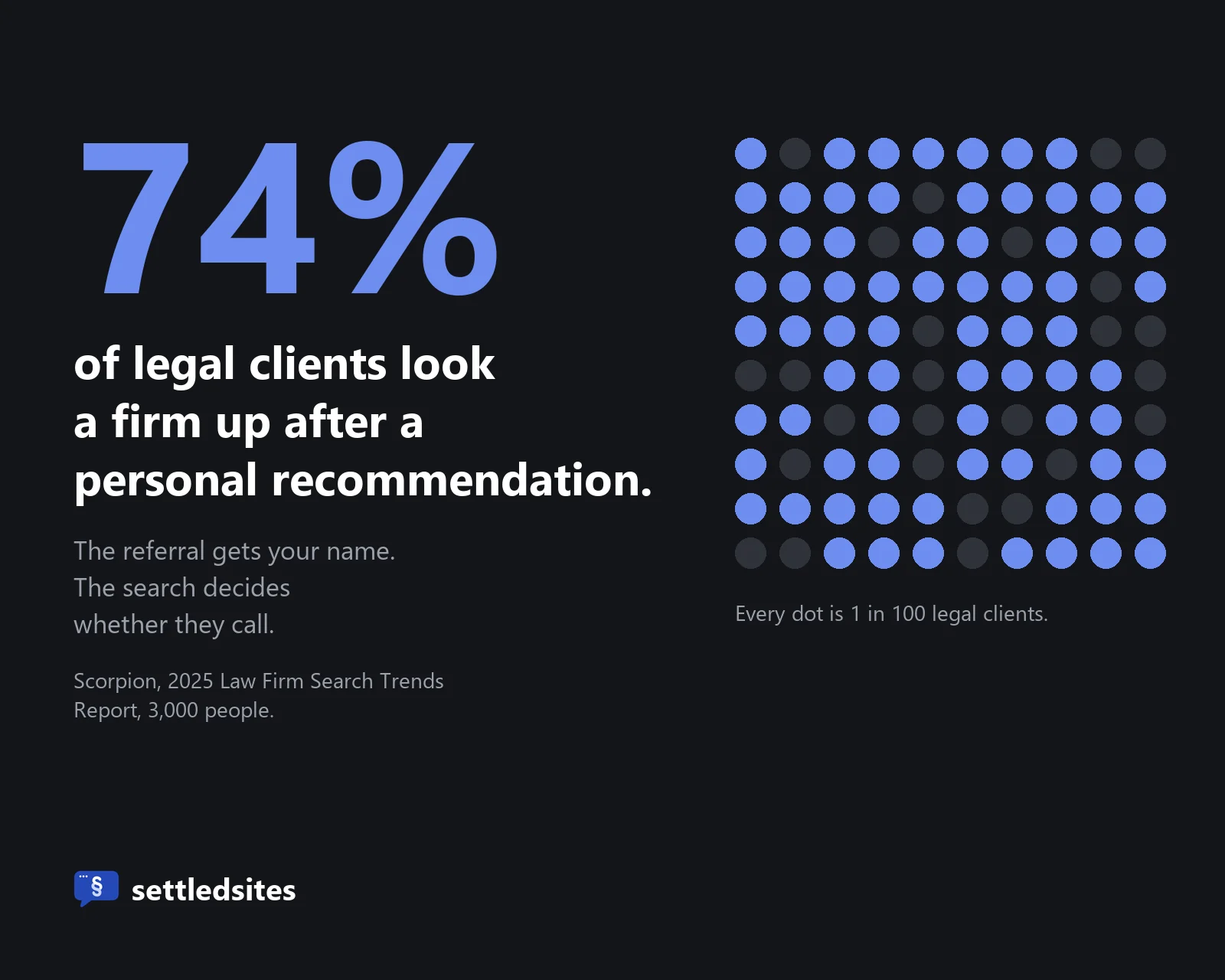
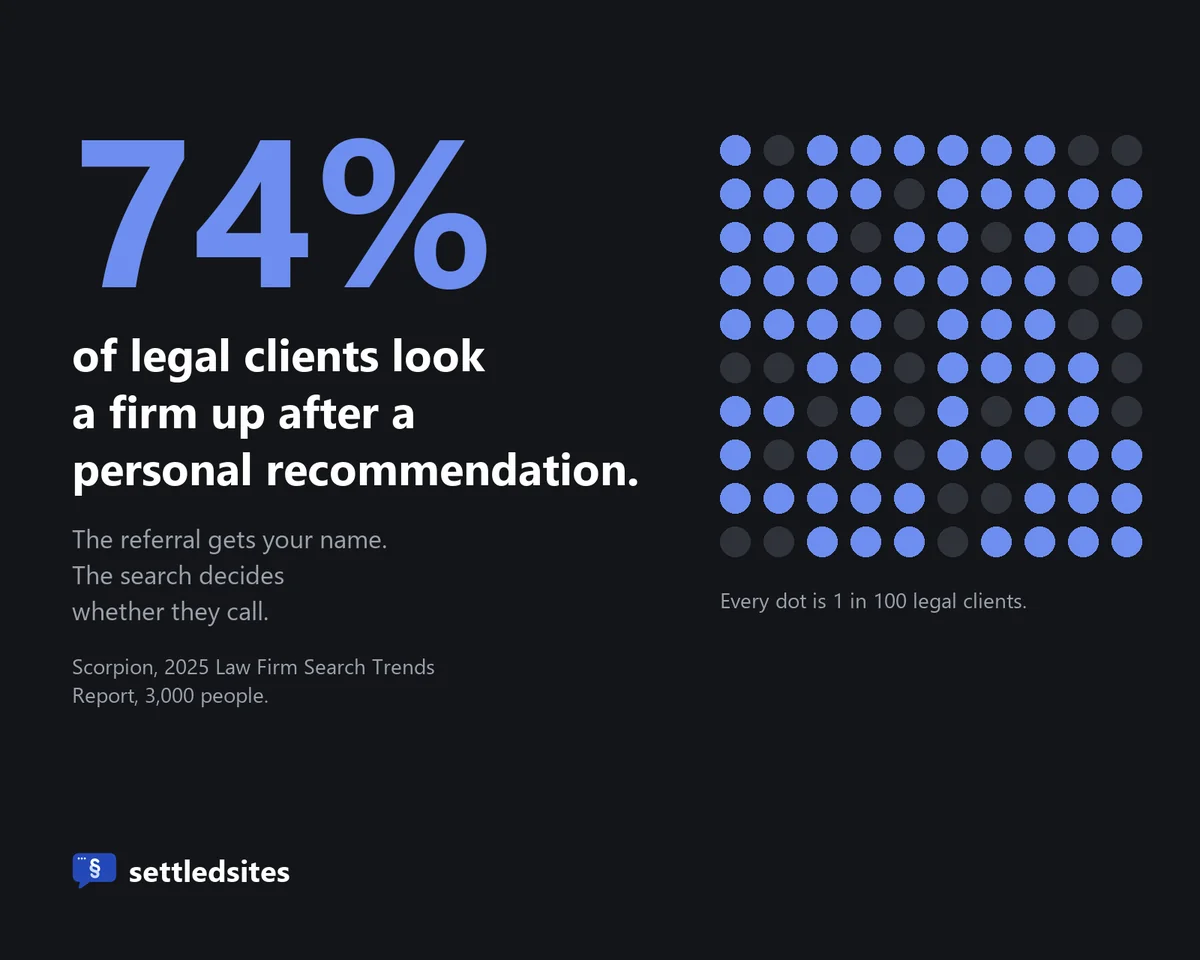
74%research a firm online after a personal recommendationScorpion, 2025, 3,000 people
97%of people who looked up the lawyer they contacted used a search engineFindLaw, 2024
And it isn't a quick glance. In Martindale-Avvo's survey, 46.9% of people with a recommendation went on to research the lawyer's reputation online.
They're online anyway. Pew found in 2025 that 41% of US adults are online "almost constantly," and 63% of adults under 30.
What does a referred client see when they search your name?
Try it right now. Search your own name the way a stranger would. What comes up first? If it's a directory profile you never filled out, an old photo, or nothing at all, that's the first impression your best referral source just handed you.
Reviews are part of the check. BrightLocal's 2026 survey found 97% of US consumers read reviews for local businesses, and 41% always do. For lawyers specifically, FindLaw found 82% of people who found their lawyer online used reviews to decide, and Martindale-Avvo found 61% want to see more than 10. We cover how to get them, inside your state's rules, in how to get more Google reviews for a law firm.
This is where owning your own site matters. Your Avvo or LinkedIn profile looks like everyone else's and lives by their rules. Your own site says what you want, the way you want, at an address that's yours. More on paid profiles in are lawyer directories worth it.
What if your site looks old, broken or hacked?
Having no site is one problem. Having one that looks neglected can be worse, because it's the first thing your referral sees after hearing how good you are.
When we checked 5,241 Illinois law firm websites in October 2026, 830 had a problem a visitor hits in the first ten seconds:
337sites didn't load at all
341showed the browser's "Not secure" warning
269broke on a phone
We wrote that up in 830 Illinois law firm websites are turning clients away, with a two-minute test you can run on your own site.
Think about what a referred client does next. They were told you're the person to call. Then the site won't load, the browser warns them off, or a design from 2012 won't fit their phone. They don't call to ask why. They go back to their friend for another name, or pick the next firm on Google.
Out of date does the same damage more quietly. A copyright line that still says 2019, a "latest news" post from three years ago, an attorney who left the firm, old office hours: none of it is broken, but together it says nobody's home. A referred client can't tell a busy practice with an old site from a firm that has closed. In our check, more than half of the Illinois firm sites on Wix that show a year still showed 2024 or earlier.
The fix is small signs of life, kept current:
- This year in the footer, and a "last updated" date on pages that change
- Your current attorneys, staff, hours and address
- Something recent: a new article, a case type you've added, a note about a change at the firm
- A phone number and email that someone answers today
We list the other usual reasons a site doesn't bring calls in law firm website not getting leads.
A hacked site is the worst version. If Google believes someone has changed pages on your site, it can show "This site may be hacked" under your name in the search results, and it tells people not to visit until the message is gone. For a lawyer, whose whole pitch is trust and keeping things confidential, that's a hard first impression to recover from.
Who else do they find when they search?
Your competitors. A friend tells someone in Naperville, Illinois to call you about a divorce. They search your name, and Google shows them other family law firms too. Within 20 miles of Naperville, there are 1,416 law firms with websites, and 461 of them list family law.
It isn't only the suburbs. Downstate there are fewer firms, but it's the same moment: the referral gets you on the list, and what they find decides whether you stay there.
- Naperville: 1,416 law firms with websites within 20 miles (461 list family law)
- Rockford: 139
- Peoria: 121
- Springfield: 69
Our count of Illinois law firms listed on LawyerPricing that have a website, measured from each city's center, November 2026.
What does a referred client see when they search your name? We'll check for you, free.
Can referrals dry up?
Of course they can. Your best referral source retires, moves, or starts sending work to their nephew who just passed the bar. Lawyers say it plainly. One solo lawyer wrote on Reddit: "I lasted 9-10 years with no marketing. I thought if I lasted 5+ years, I'd have enough referrals. Didn't work out that way."
Another said that tap "has dried up" recently. And a site can help even a referral practice. One firm that gets most of its work from referrals paid $2,500 once for a simple new site and got "more cold calls from it than I have ever had" with the monthly vendor before it. If you'd like search to bring in work as well as referrals, read does SEO work for small law firms.
When does a referral-only lawyer need less?
When your work comes from other lawyers or the courts, not from the public. One lawyer put it bluntly: "If you get all of your referrals from other attorneys or the courts, then you don't really need a website." Fair enough.
But even then, the site is how people confirm you're real. A lawyer for health care providers said on Reddit that fewer than 3% of his clients come from his website, and he still says, "make sure you have a quality, sticky website." For a practice like that, you don't need a blog or ads. You need a clean, current page that tells another lawyer exactly what you do, and that you're still doing it. Here's what a law firm website costs, from a simple site up.
Questions lawyers ask about referrals and websites
Do I need a website if all my work comes from other lawyers?
You need less, but not nothing. Lawyers who refer to you will look you up before they put their name next to yours, and so will the clients they send. A simple, current site with your practice areas, your bio and working contact details does the job. It doesn't need a blog or ads.
Should I trust a lawyer who doesn't have a website?
Plenty of good lawyers don't have one, so it isn't a red flag on its own. But clients do hesitate. They can't see what you do, who you are or how to reach you, so they move on to the next name. A missing site mostly costs you the people who never call to ask.
Is a LinkedIn or Avvo profile enough?
It's better than nothing, but it isn't yours. The platform decides how your profile looks, what sits next to it, and whether it stays up. Competitors can advertise on it. Your own site, on your own domain, says what you want and stays put. Keep the profiles too, and link them to it.
Can a solo with no office get a Google Business Profile?
Yes, if you meet clients in person. If you go to them, list as a service-area business and hide your home address. A shared office works if it has your sign, your staff and takes clients during your hours. A mailbox or virtual office address doesn't qualify, and Google's rules don't cover video-only practices.
What's the least I need online if I'm all referrals?
A short site on your own domain that says what you do, where you do it, who you are, and how to reach you, with a phone number and email that work. Add a Google Business Profile and a few honest reviews. That's enough for a referred client to confirm you're real and pick up the phone.
Sources
- Martindale-Avvo, Understanding the Legal Consumer 2023 (about 1,850 consumers who had used its sites, so the group leans toward people who go online)
- Localogy on Scorpion's 2025 Law Firm Search Trends Report
- FindLaw, 2024 U.S. Consumer Legal Needs Survey
- BrightLocal, Local Consumer Review Survey 2026
- Google Search Help, "This site may be hacked"
- Pew Research Center, internet use, January 2026
- SettledSites analysis of Illinois law firm websites listed on LawyerPricing, November 2026
- Lawyer comments in r/LawFirm and r/Lawyertalk, 2023 to 2026
Written by Gaston Sitbon and Mark Jarvis, co-founders of SettledSites. Facts checked November 18, 2026.
Keep reading
See your own firm's new homepage before you pay anything.