How do I get more Google reviews for my law firm without breaking the rules?
The easier you make it, the more people say yes.

By Gaston Sitbon, co-founder of SettledSites
Published · Last reviewed
Short answer: Ask every client, the same way, at the right moment, with a direct link. That's most of it. What you can't do is pay for reviews, offer anything in exchange, or only ask the happy ones. Google bans that, the FTC bans fake reviews and paying for positive ones, and your state bar has its own rules about paying for recommendations. Get the asking right, then let your clients do the talking.
When someone searches for a lawyer near them, the first thing they see is often your star rating and how many reviews you have. Before they read a word on your website. So reviews aren't a nice extra. They're part of your front door.
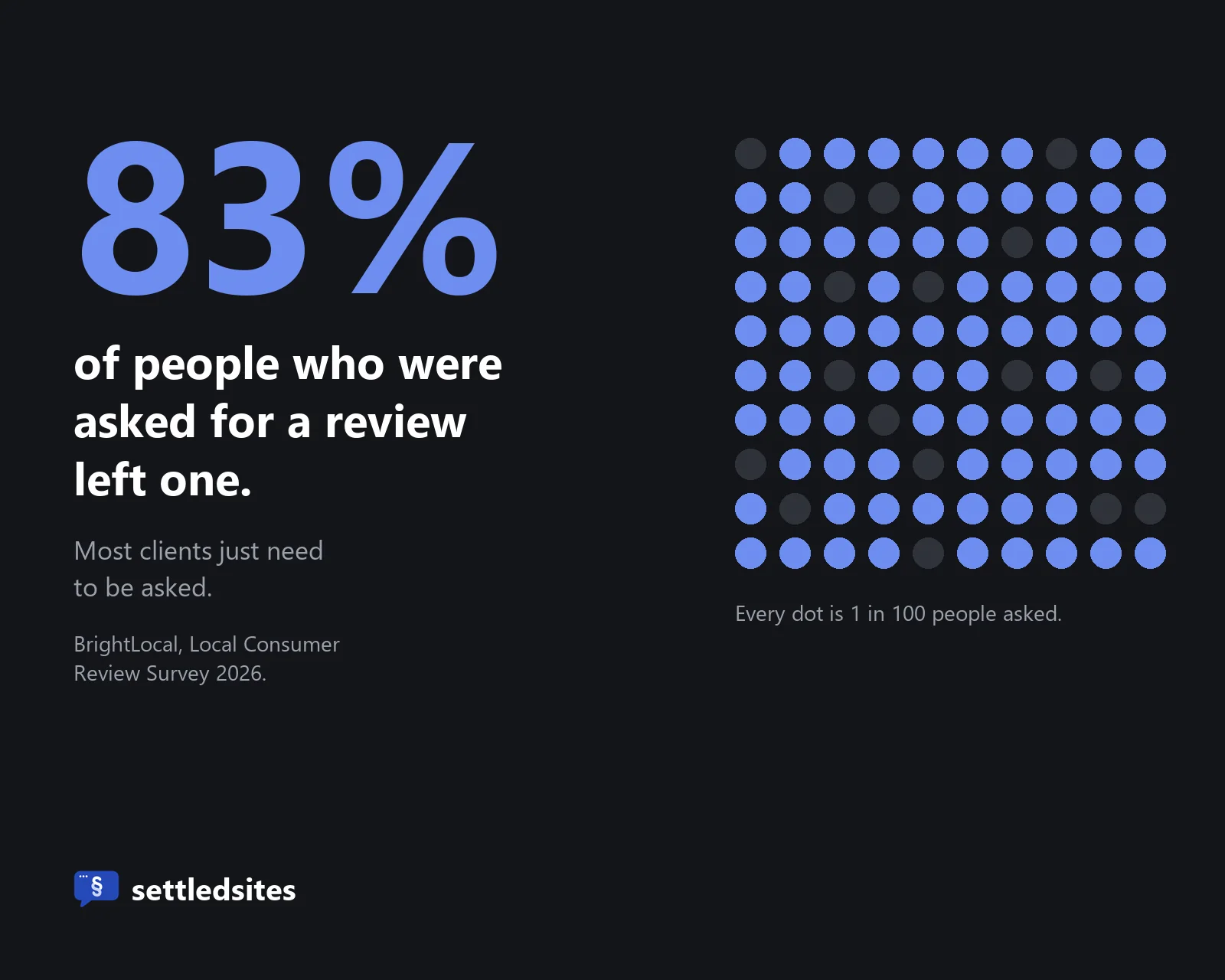
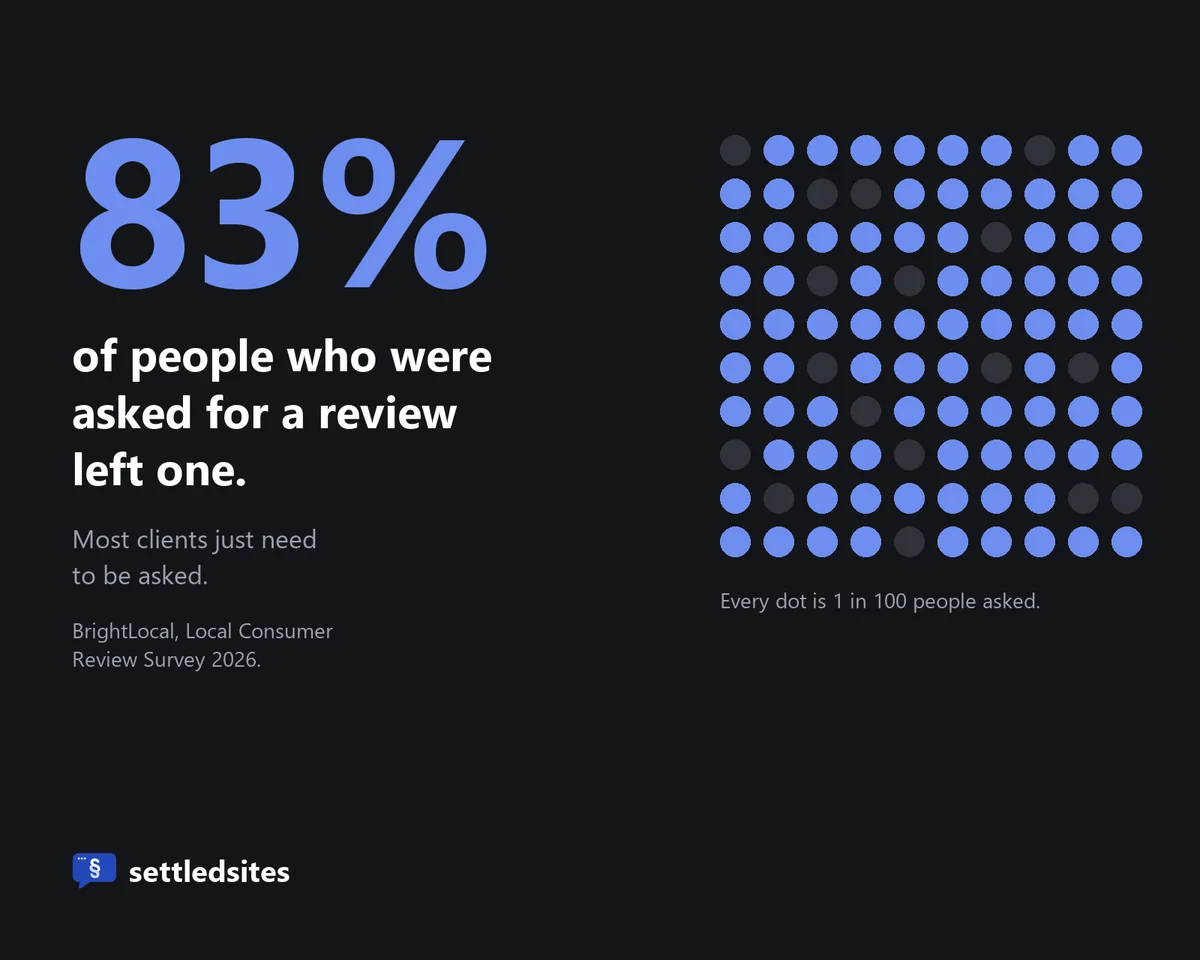
83%of people who were asked for a review left oneBrightLocal, 2026
74%of people only care about reviews from the last three monthsBrightLocal, 2026
28states, Illinois included, where you can't give even a small thank-you gift for a review that recommends youSettledSites state rules check, 2026
Why do Google reviews matter so much for law firms?
Because Google uses them, and so do people. Google's own help pages say your star rating and number of reviews affect how you rank in Local Services Ads. And a potential client comparing three firms on a map will tap the one with 40 reviews before the one with 3.
Reviews also say things you can't say about yourself. You can't call yourself "the best divorce lawyer in town." A client can say you returned every call and explained everything twice without making them feel stupid. That's worth more.
When should a lawyer ask for a review?
When the client is most likely to remember how you helped them. For most practices, that's right when the matter wraps up: the case closes, the deal is signed, the will is executed. Not months later when they've moved on.
Just don't send it with your final invoice. Nobody feels like writing a review while they're looking at a bill. Give it a few days after the invoice goes out, and do it the same way for every client, win or lose. Choosing when to ask is fine. Choosing who to ask isn't.
Make it part of your closing routine, not something you remember to do when it's slow. If every closed matter gets the same request, you never have to think about it, and you never fall into asking only the clients you think will be happy.
How do I ask clients for a Google review?
Make it one tap. If a client has to search for your firm on Google, find your profile, scroll, and hunt for the review button, most of them give up before they get there. A direct link opens the review box with your firm already picked, so all they have to do is tap the stars and type.
Bonus points if they post a photo of you standing over opposing counsel like Ali over Liston. Kidding. Mostly.
- Get your direct review link. In your Google Business Profile, use the option to ask for reviews. It gives you a short link that opens the review box directly.
- Send it by text or email, the same message for everyone. Short and plain: "Thank you for trusting us with your case. If you have a minute, an honest review helps other people find us." Then the link.
- Ask once, follow up once. One reminder a week later is fine. More than that starts to feel like pressure.
- Ask for an honest review, not for five stars. Of course five stars is the goal. But you get there by doing great work and asking every client, not by putting a number in the request. "Please leave us five stars" reads as pressure, and a happy client will give you five stars without being told.
- Reply to reviews, carefully. A short thank-you on good ones. On bad ones, never get into a fight. Reviews work like social media posts: the more back-and-forth one gets, the more people see it. We've all seen a restaurant owner argue with every bad review and turn one unhappy customer into a local news story. Before you reply to a bad one, read the next section.
What are the rules for lawyer reviews?
This is where lawyers get tripped up, because three sets of rules apply at the same time: Google's, the FTC's, and your state bar's. Here's what each one says, in their own words where it matters.
You can:
- Ask every client for an honest review
- Send the same request to everyone, by text or email
- Give them a direct link to make it easy
- Thank people who leave reviews, publicly or privately
- Ask Google to remove a review that's fake or breaks its policy
You can't:
- Pay for reviews, or give a discount, gift or freebie in exchange
- Only ask the clients you think will be happy
- Discourage or pressure people out of leaving a bad review
- Write reviews yourself, or have staff or family write them
- Reveal anything about a client's case when you reply to a review
Google. Google's policy bans offering anything "in exchange for posting any review or revision or removal of a negative review." It also says businesses may not "discourage or prohibit negative reviews, or selectively solicit positive reviews from customers." Break those rules and Google can remove reviews or restrict your profile.
The FTC. Since October 21, 2024, the FTC's rule on consumer reviews has banned fake reviews, buying reviews that have to be positive, and suppressing negative ones through threats or false accusations. The rule's section on reviews from insiders, like relatives and employees, expressly leaves out general requests sent to all your customers.
Your state bar. In Illinois, Rule 7.2(b) says: "A lawyer shall not give anything of value to a person for recommending the lawyer's services," with a few listed exceptions, like paying the reasonable cost of advertising. The comment to the rule says a communication is a recommendation if it "endorses or vouches for a lawyer's credentials." Other states word this differently, and some have extra rules on testimonials.
SettledSites sets up your review requests around your own state's rules.
Before you reply to a bad review, read this. Don't defend yourself with the facts of the case. In Formal Opinion 496 (2021), the ABA said a negative online review, on its own, doesn't let you use the self-defense exception to reveal confidential information.
The opinion says lawyers should consider not responding at all. If you do respond, keep it general, like inviting them to call you. The opinion offers this sample wording: "Professional obligations do not allow me to respond as I would wish."
What if my firm only has a few reviews?
Start with the clients you closed this month, then work back through the last year. Same message, same link, everyone. A steady trickle of honest reviews beats one burst of fifty and then nothing: in BrightLocal's 2026 survey, 74% of people said they only care about reviews from the last three months.
And don't panic about one bad review. In the same survey, 68% of people said they'd only use a business with 4 stars or more, so a 4.7 still clears the bar.
Want help setting up review requests that fit your state's rules? Start with a free review of your site and Google profile.
Questions lawyers ask about Google reviews
Can a lawyer ask clients for Google reviews?
Yes, as long as you ask every client the same way and give nothing in exchange. See the rules.
Can I offer a discount or gift card for a review?
No. Google and the FTC both say no, and in 28 states, Illinois included, even a small thank-you gift for a review that recommends you is out. See the rules.
How should a lawyer respond to a negative Google review?
Carefully, and often not at all. Never with case facts: see what ABA Formal Opinion 496 says.
Can a law firm show its Google reviews on its website?
Illinois's rules don't have a section written just for testimonials. Rule 7.1 says: "A lawyer shall not make a false or misleading communication about the lawyer or the lawyer's services." Show real reviews word for word. Other states differ. SettledSites can pull your Google reviews onto your site, styled to match, with the right disclaimer for your state.
Can I remove a bad review from my Google profile?
You can ask Google to take down a review that breaks its policies, like a fake one. Offering anything to get a bad review removed is against Google's policy.
Sources
- Google, Maps user-generated content policy (fake engagement and rating manipulation)
- Google Business Profile Help, what happens when reviews break the fake engagement policy
- FTC, Trade Regulation Rule on the Use of Consumer Reviews and Testimonials, 16 CFR Part 465 (Federal Register, August 22, 2024)
- Illinois Rules of Professional Conduct, Rule 7.2 (amended effective July 1, 2025)
- Illinois Rules of Professional Conduct, Rule 7.1 and comments
- ABA Formal Opinion 496, Responding to Online Criticism (January 13, 2021)
- Google Local Services Ads Help, reviews and ranking
- BrightLocal, Local Consumer Review Survey 2026 (1,002 US adults)
- SettledSites state rules check of 50 states and DC, November 2026
Written by Gaston Sitbon and Mark Jarvis, co-founders of SettledSites. Facts checked November 5, 2026. Rules quoted as published; we update this page when they change.
Keep reading
See your own firm's new homepage before you pay anything.