Does SEO work for small law firms? When it pays off and when it doesn't
Search or referral? For most firms, it's some of both.

By Gaston Sitbon, co-founder of SettledSites
Published · Last reviewed
Short answer: Yes, if you get specific. Don't chase "divorce lawyer." Go after "uncontested divorce, north side of Chicago, Spanish-speaking," and Google and AI tools can put you right in front of that client. It's slow (Google says four months to a year), but it's worth it in the long run. If most of your work comes from referrals, your site's main job is to prove you're real.
"Is SEO fake?" is a real thread title on Reddit, with a moshpit of more than 80 comments arguing about it. We get the same question on almost every call. Here's our honest answer, with what lawyers report and what Google itself says.
4 to 12 monthsfor SEO to start paying off, in Google's own wordsGoogle, 2017
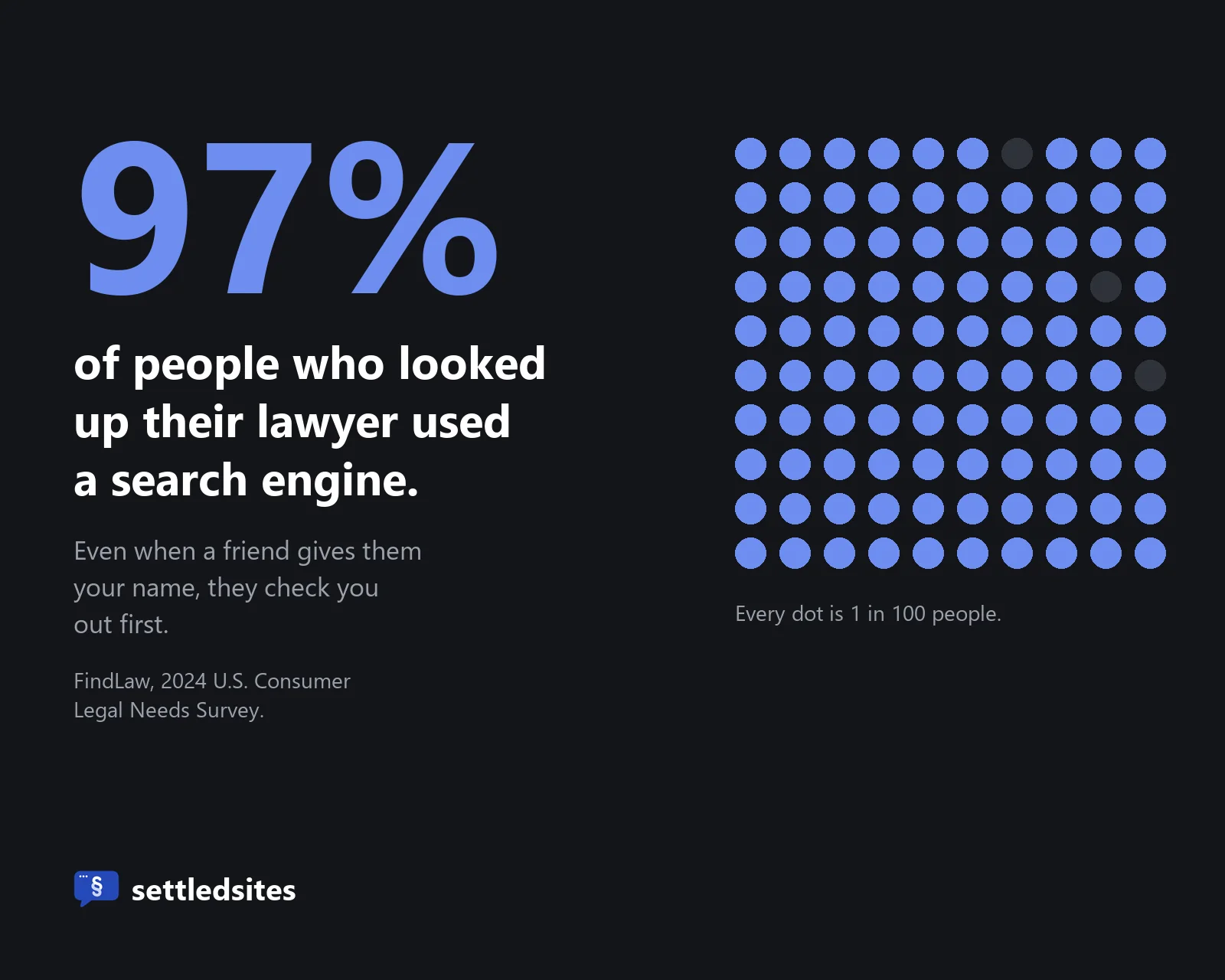
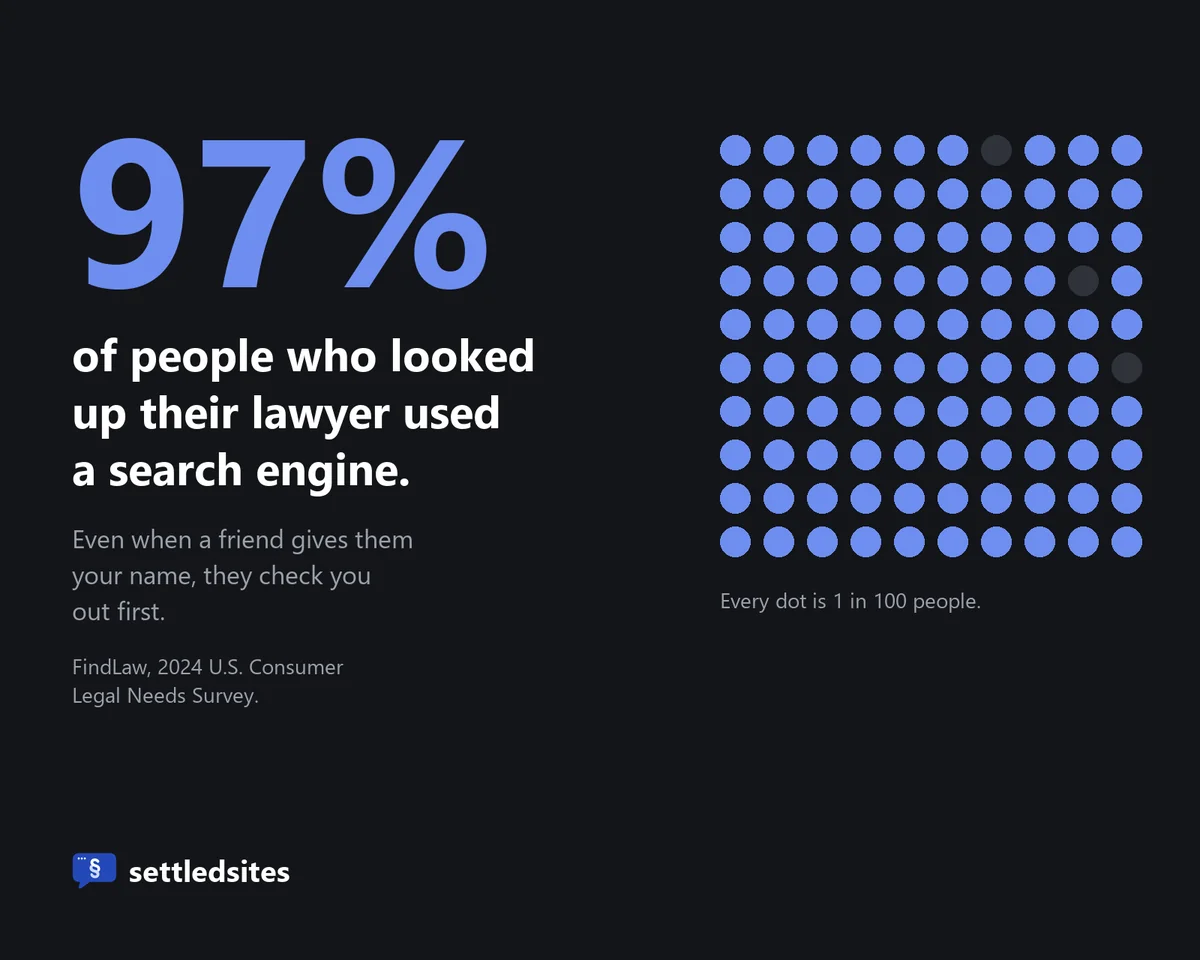
97%of people who checked out their lawyer online did it through Google or another search engineFindLaw, 2024
5 yearsthe average age of the page ranking first on Google. SEO rewards patience.Ahrefs, 2025
Does SEO work for law firms?
I have to give credit where credit is due. If you're here, reading these words, SEO works.
Look, we're two guys, one in Chicago and the other in the UK. We started this because we thought we could do a better job than the multimillion-dollar firms. I'm writing this right now staring at Loyola's north side campus from my apartment window in Rogers Park. So done right, yes, it works.
For law firms, one size doesn't fit all. I can't promise people will read every word on your site, but Google and AI tools probably will. And if they read it and find it clear and relevant, they'll file it away and show it to the right people.
How far that gets you depends on how narrow you go, or as they say in marketing, how far into the long tail. You can't be as popular as Coca-Cola or Nutella, but you can be as specific as Marmite (Mark is a fan, I'm not). So instead of trying to win everyone searching for "divorce lawyer," go after the person searching for "divorce lawyer for an uncontested divorce with no children on the north side of Chicago who speaks Spanish."
When I searched something that specific, Google sent me straight to one person. That's SEO and GEO (or showing up in AI answers) working in your favor when it's done right. Being specific puts you front and center, for free.
Now, there were sponsored results above that one. Ads are a smart move when you need calls this week, and a well-run campaign can pay for itself many times over. But you pay for every click, and the day you stop paying, the spot goes to someone else. Think of it as paying for a hotel suite with a great view. It's got potential, but every day adds to the cost.
SEO is owning. It takes longer to build, but it's there. I could probably type the same search next week (or even next month) and get the same result, and that law firm gets the click for free.
The firms that do well usually use both: ads for calls now, SEO for calls that keep coming.
The lawyers we read are split. We read 22 comments in lawyer forums where people described where their own firm's clients come from. Twelve said search or ads is a main source. Ten said referrals are. An estate planning firm said SEO brings in more than half its business and has doubled its gross. A lawyer for health care providers said fewer than 3% of those clients came from the website.
- Search or ads is a main source: 12. Family law (4 firms), estate planning, real estate, transactional, criminal defense, and workers' comp, niche and other (4).
- Referrals are the main source: 10. Health care provider work, personal injury (2 lawyers), wrongful death and catastrophic cases, litigation, family law (2 lawyers) and other (3).
Where 22 Reddit commenters say their firm's clients come from. 22 comments we read, not a survey: 17 by lawyers, 1 by office staff and 4 who didn't give their role, describing their own practices, 2023 to 2026. A small, self-selected group.
Which practice areas get the most from SEO?
The ones where a regular person picks up a phone and searches for help. Divorce, wills, a DUI, a house closing. Those people don't have a lawyer friend to call, so Google is their friend.
Personal injury is the exception that proves the rule. Everyone searches for it, so everyone's fighting for it. One lawyer calls PI search saturated and another commenter calls it "a very real way to blow a wad of cash." A small PI firm usually does better going narrow, like one type of accident in one town, than going head to head with the billboard firms.
Business defense, insurance defense and other work that comes from businesses or other lawyers is different again. Those clients rarely search for you cold. But when someone refers them, they look you up. For those firms, the site is a handshake before the handshake. We dig into that in do lawyers need a website if clients come from referrals?
How long does SEO take for a law firm?
I'm writing this for the first time on November 10, 2026, and I review it every so often. If you're reading it before the end of 2026, that's a good sign: it means this page got found within weeks of going live.
What I've seen with the sites Mark and I have worked on is that it takes a few months to get ranked. As work keeps going into the site, those rankings get stronger. Google's own estimate is about the same: in a 2017 video on hiring an SEO consultant, Google said it takes "four months to a year" to see the benefit.
Four to twelve months sounds like forever. But you're not practicing law as a temporary gig. You're playing the long game, and this is the long game play.
And Ahrefs, which sells SEO software, found in 2025 that the average page ranking first on Google is about five years old.
That doesn't mean anything is guaranteed, and it doesn't mean you should start posting every day. You can if you want. Just make sure you have something interesting to say, and that it's authentic.
It's not just about posting, either. Once your pages are out there, crawled and indexed, look at what you've got and start shaping it. If you have two posts about residential real estate closings and both are indexed, combine them into one so they aren't competing with each other. And take your top-ranking pages and shine a light, with an internal link, on another post you'd like people to find, the same way you'd introduce a shy friend to a group of people.
We practice what we preach. Go ahead and click through our posts and check them. See how each one answers a specific question, how they all link to one another, and how none of them compete with each other.
Sorry, I get excited about this stuff and tend to go off on a tangent.
- Launch: Google finds and indexes your pages
- Month 4: the low end of Google's estimate
- Month 12: the high end of Google's estimate
- Year 5: the average age of a #1 page
How long SEO takes to pay off. Sources: Google, "How to hire an SEO" (2017), as reported by Search Engine Roundtable; Ahrefs, May 2025, 1.3 million US keywords.
Want to know what searches your site could realistically win? We'll take a look for free.
Do clients still search for lawyers online?
No, the days of searching online for lawyers are over. These days people walk into the town square holding a sign that says "NEED A LAWYER."
Come on, be serious. Google is the biggest game in town, and now it's not just search, it's AI answers too. In a 2024 survey by FindLaw, which sells marketing to law firms, of 2,000 adults with a legal need in the past year, 97% of the people who looked up the lawyer they contacted used a search engine. Even when a friend gives them your name, they check you out first.
What should SEO cost a small law firm?
Some lawyers we read report SEO retainers around $2,500 a month, and one put the cost of competing at about $3,000 a month. Some get quoted far more. The estate planning firm above pays about $2,500 a month and is happy with it, and another lawyer called it money well spent.
Then there's the other camp. One attorney wrote that low-tier local packages, around $800 to $2,500 a month, are a waste of money. Another commenter said firms get burned because it's easy to say you're doing work without doing any.
Here's how to tell good SEO from expensive SEO, whoever you hire, us included.
What separates good SEO from expensive SEO is what's left when the month ends. Good SEO builds things you keep: pages that answer real client questions, a Google Business Profile that's complete and current, steady reviews, and a site that loads fast and stays in shape. Those keep working next month whether you add to them or not, and each month of work stacks on the last.
And it's 2026, so don't forget about AI. Good SEO now also means keeping track of where you show up in tools like ChatGPT and Google's AI answers, checking how they describe your firm, and steadily tweaking your pages to improve those results. More in how to get your firm recommended by ChatGPT.
Whatever you pay, get a written list of what's done each month, and make sure Google Analytics and Search Console are in your name, so you can see the results yourself.
Questions lawyers ask about SEO
Does SEO work for defense firms, or is it just for credibility?
Mostly credibility, but narrow searches in your niche still help and cost far less to win than consumer ones. More in do lawyers need a website if clients come from referrals?
How long until SEO brings calls for a new firm?
Google's range is four months to a year. Use the wait well: claim your Google Business Profile, ask every client for a review, and publish pages that answer specific questions.
Is a small Google Ads budget worth it while SEO kicks in?
It can be, if you keep it tight: one practice area, a small area, and ads that send people to a matching page instead of your homepage. Count signed cases, not clicks. For Google's Local Services Ads, see our Local Services Ads post.
Does a paid directory listing help my SEO?
Not much. A paid listing mostly buys you a better spot inside that directory. More in are lawyer directories worth it?
Can I do my own SEO?
Yes, and some lawyers do. One solo spent six months building a site and learning SEO, and now gets more inquiries than they can take. The work is mostly writing specific, useful pages and keeping them current. The real cost is your time, so weigh it against your hourly rate.
Sources
- Google, SEO Starter Guide
- Google Search Central, "How to hire an SEO" video, 2017
- Search Engine Roundtable on Google's "four months to a year" video, 2017
- Ahrefs, How long does it take to rank in Google, May 2025
- FindLaw, 2024 U.S. Consumer Legal Needs Survey
- Lawyer comments in r/LawFirm and r/Lawyertalk, 2023 to 2026
Written by Gaston Sitbon and Mark Jarvis, co-founders of SettledSites. Facts checked November 10, 2026.
Keep reading
See your own firm's new homepage before you pay anything.