How do I get my law firm recommended by ChatGPT?
The new version of asking a friend for a referral.

By Gaston Sitbon, co-founder of SettledSites
Published · Last reviewed
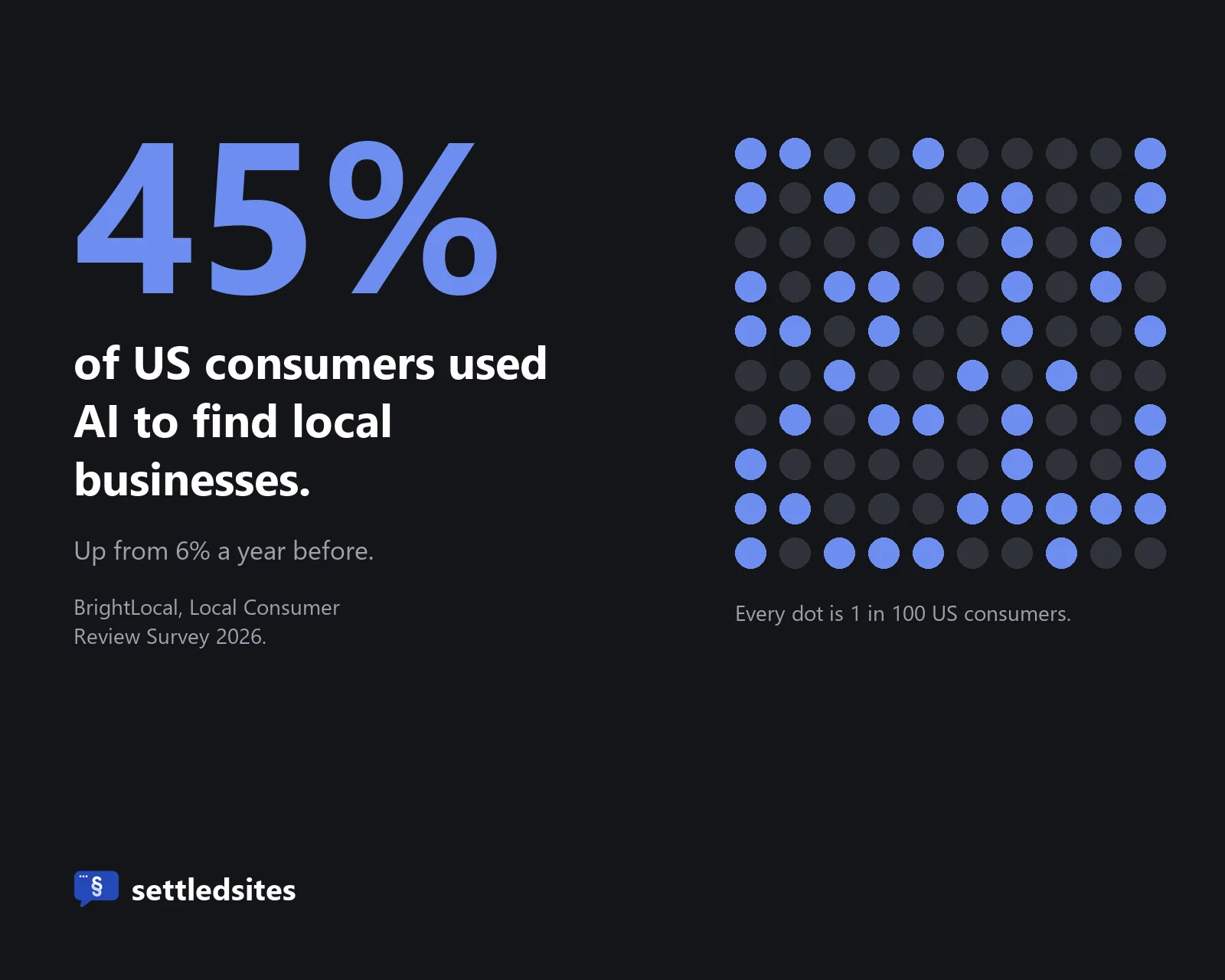
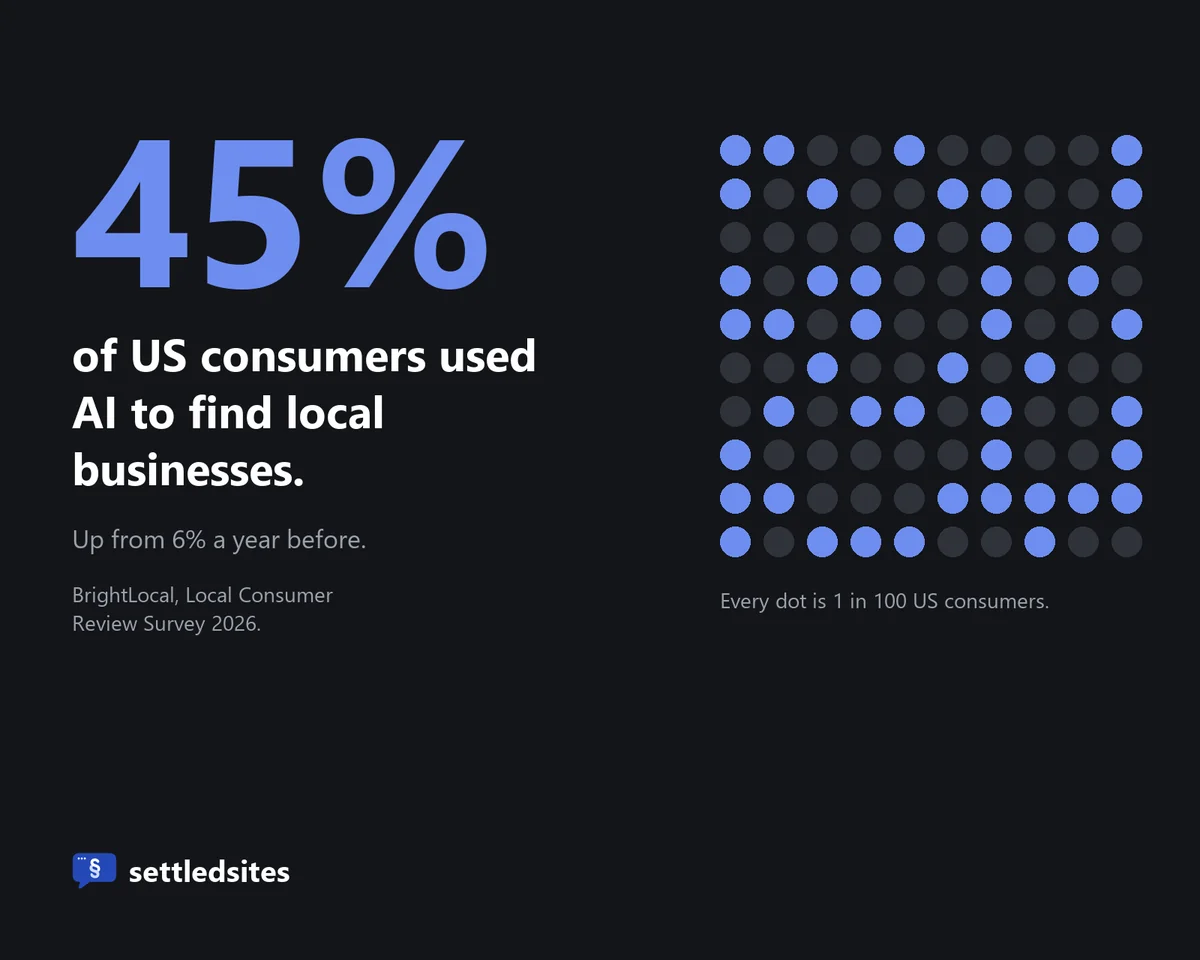
Short answer: Nobody can promise you a spot in ChatGPT's answer, and you should be wary of anyone who does. But it isn't black magic either. AI tools recommend firms they can read, that show up consistently across the web, and that other sites talk about. It's still early, but it's moving fast: in BrightLocal's 2026 survey, 45% of US consumers said they'd used AI tools for local business recommendations, up from 6% a year before. That's what makes now the time to show up.
More and more people skip the search results and just ask: "Who's a good divorce lawyer in Naperville?" The AI answers with a few names. Some lawyers we read say ChatGPT already sends them paying clients. Others call it black magic. Here's what we actually know about how to be one of those names, and what nobody knows yet.
49%of Americans use AI chatbots, up from 33% in 2024Pew Research Center, 2026
45%of US consumers used AI tools for local business recommendations, up from 6% a year beforeBrightLocal, 2026
8of 5,101 Illinois firm sites block AI search or AI assistant bots from reading themSettledSites check, November 2026
If AI skips you, blocked bots are probably not why.
Is it too early to care about AI search?
Let me answer that with a story. In August 2008, Barack Obama passed Digg's founder to become the most-followed person on Twitter, with about 56,800 followers. His opponent, John McCain, didn't have an official account at all.
56,800 people isn't a lot. Plenty of people back then thought Twitter was a toy. But the campaign that showed up early learned the channel while it was small, and it had a head start when everybody else arrived.
AI search is in that spot right now. About half of Americans use AI chatbots, according to Pew. But when Pew asked in October 2026 who'd used one to look up election information, only 8% said yes. People are using it, but they haven't moved their big decisions there yet. For local businesses it's already happening, as BrightLocal's 45% above shows. Finding a lawyer is next.
Personally, I don't buy those numbers. I think the real ones are much higher. My Mom is over 70, is far from tech savvy, and rarely is she NOT using her phone to look things up throughout the day, using AI. I suspect a lot of people don't even think of asking ChatGPT as "looking something up," so they don't count it when a survey asks.
- Use AI chatbots, 2024: 33%
- Use AI chatbots, 2026: 49%
- Used one for 2026 election information: 8%
How many Americans use AI chatbots, and for what. Pew Research Center: AI use from its February 2026 survey of 5,119 US adults (2024 figure as reported by eMarketer); election information from its October 2026 survey of 5,273 US adults.
How does ChatGPT decide which lawyers to recommend?
Nobody outside these companies knows the exact recipe, and it changes. But when ChatGPT, Gemini or Perplexity search the web to answer a question, they pull from pages they can read. A few things clearly help:
- Your site lets AI search bots in. If your site blocks them, you can't be quoted. Good news: in our check of 5,101 Illinois firm sites, only 8 blocked an AI search or answer bot (5 of them by blocking every bot). Blocking the bot that trains ChatGPT is a different switch and doesn't take you out of its search answers.
- Your site says plainly who you are. Your name, what you practice, where, which bars you're admitted to, and how to reach you, in plain text, not buried in an image. AI tools can't recommend a divorce lawyer in Naperville if your site never says "divorce" or "Naperville."
- The same facts show up everywhere. Your Google Business Profile, your bar listing, directories, and your website should all match: same name, address, phone and practice areas. Google's own guidance for its AI answers says to keep your Business Profile up to date.
- Other sites talk about you. Reviews, local news, bar association pages, articles you've written. AI tools lean on what others say about you, not just what you say about yourself. In Whitespark's 2025 survey of local search professionals, 3 of the top 5 factors for showing up in AI search were about other sites mentioning you.
- You answer real questions. Pages that explain, in plain language, the questions clients actually ask. That's what these tools are looking for when someone types a question. In a 2024 study of AI answers, adding real statistics, quotes and sources raised a page's visibility by up to 40%, and keyword stuffing did worse than doing nothing.
In an earlier post, should lawyers write their own website content, or use AI?, I said AI is excellent at analyzing large amounts of information quickly. This is no different, just on a global scale, and with the purpose of finding everything it can about you.
None of this is a trick. It's the same stuff that makes a good website for people, done carefully. Everything SettledSites builds is written to be read by people and AI tools alike, and checked against your state's advertising rules before it goes live.
Does any of this actually work?
That's the right question, and we'd rather show you than tell you. Fair warning: it takes a while. Here's what it looked like for DispuPoint, my other company, which helps Illinois homeowners with HOA and condo disputes.
Every week, an automated survey asks OpenAI's GPT, Google's Gemini and Anthropic's Claude the same set of questions homeowners actually ask, like "my HOA board is ignoring my emails, what can I do?" It logs every answer in a spreadsheet: was DispuPoint named, was our site cited, and which competitors showed up instead.
- GPT: 36.2%
- Gemini: 25.9%
- Claude: 12.1%
How often AI tools named DispuPoint by November 1, 2026: share of 58 homeowner questions (50 before June 28) where each model named it. DispuPoint's weekly AI survey, June 1 to November 1, 2026.
In early June, DispuPoint barely existed to these tools. By November 1, GPT named it in 36% of answers, Gemini in 26% and Claude in 12%. To be fair, 8 of those questions mention DispuPoint by name. On the ones that don't, the numbers are lower, and those are the ones we're working on now.
Google and Bing (Microsoft, one of the search engines behind ChatGPT's web search) are counting too. Google's Search Console now reports how often a site shows up in Google's AI answers, and Bing Webmaster Tools reports how often Microsoft's Copilot cites it. For DispuPoint, that went from about 10 times a day in early August to 60 to 90 times a day by early November.
We can run the same kind of weekly survey for your practice area and your city. Then we dig into the results with our own in-house tools: which questions you show up for, which ones you don't, and which sites the AI is quoting instead of yours. We use that to keep tweaking your pages. Some weeks the numbers move, some weeks they don't, and you see all of it, not just the good weeks.
What should I avoid?
- Anyone who guarantees you'll be recommended. They can't control what an AI says. Nobody can.
- Stuffing your site with AI-written filler. Pages that say nothing don't help people, and they don't give AI tools anything worth quoting.
- Fake reviews or paid reviews. See how to get more Google reviews the right way.
- Ignoring your Google profile. It's one of the places these tools check for basic facts about local businesses. In BrightLocal's August 2026 study of AI answers to lawyer searches, 42% of the sources cited were Google; Avvo was 2.5% and FindLaw 0.9%.
How do I check if ChatGPT recommends my firm?
Ask it, the way a client would. Open ChatGPT, Gemini and Perplexity and type the questions your clients ask: "Who's a good DUI lawyer in Joliet?" or "I need help with my mom's estate in Evanston, who should I call?" Try a few versions, and write down who comes up.
One catch: don't do it on your own phone or laptop. The AI tools you use every day remember you: your chats, your searches, maybe even your firm's name. Ask on your own account and they may name you just because they know you. Use a computer you don't normally use, or borrow someone else's phone, and stay logged out. That's the answer a stranger would get.
Do it again every month or two. Answers change, and the goal isn't to win once. It's to show up more often over time.
Curious whether AI tools can find your firm? We'll check your site and tell you what they can and can't see, free.
Questions lawyers ask about ChatGPT and AI search
Can I pay to be recommended by ChatGPT?
You can't buy your way into the answer itself. See what to avoid.
Does my website affect whether AI recommends me?
Yes, it's one of the main places they read. See how AI picks lawyers.
Should I block AI bots from my law firm website?
Not the search bots. Check your settings for any default AI-blocking switch your host turned on. Training bots are a separate switch, covered above.
Is AI search going to replace Google for finding lawyers?
Nobody knows yet. Google said in October 2026 that its search queries were growing faster than at any time in the last five years, and 60% of Americans told Pew they read the AI summaries at the top of search results. The good news is that what helps with one helps with the other: a clear, fast site, matching listings, and real reviews.
How long does it take to show up in ChatGPT answers?
There's no set timeline, and it varies by question and by tool. Changes to your site can be picked up quickly, but being mentioned across other sites takes longer. Check every month or two, using the same questions, so you can see the trend.
Sources
- Search Engine Roundtable, OpenAI on Bing as a search provider for ChatGPT search
- Search Engine Journal, Bing Webmaster Tools adds AI citation performance data, February 2026
- Pew Research Center, Few Americans say they are asking AI chatbots for 2026 election information (October 2026)
- Pew Research Center, Americans and AI 2026 (June 2026)
- eMarketer, on Pew Research Center's 2026 AI use study (2024 comparison)
- BrightLocal, Local Consumer Review Survey 2026: AI and local search (March 2026)
- BrightLocal, which sources AI answers cite for local businesses (August 2026)
- Whitespark, Local Search Ranking Factors (November 2025)
- Aggarwal et al., GEO: Generative Engine Optimization (KDD 2024)
- Google Search Central, AI features and your website
- Google, Alphabet Q3 2026 earnings remarks (October 2026)
- TechCrunch, Barack Obama overtakes Kevin Rose on Twitter (August 2008)
- OpenAI, overview of its crawlers
- SettledSites check of 5,101 Illinois law firm homepages, November 2026
- Lawyer comments in r/LawFirm, September 2026
Written by Gaston Sitbon and Mark Jarvis, co-founders of SettledSites. Facts checked November 5, 2026. AI search changes fast; we update this page when it does.
Keep reading
See your own firm's new homepage before you pay anything.