Should lawyers write their own website content, or use AI?
The draft can come from anywhere. The red pen has to be yours.

By Gaston Sitbon, co-founder of SettledSites
Published · Last reviewed
Short answer: Both, done right. You should be the source and the final check, even if someone else, or something else, helps with the drafting. Illinois Rule 7.1, for example, starts: "A lawyer shall not make a false or misleading communication about the lawyer or the lawyer's services". Every bar and court we found that has weighed in on AI puts the checking on you, and AI gets the law wrong often enough that every word has to be checked. We write our own posts this way, and we'll show you how.
Lawyers are deciding this right now: write it yourself, pay someone, or let AI do it. Here's what the bar, the courts, Google and the data say, plus how we actually do it.
898court cases worldwide involving lawyers and AI-invented content, as of November 5, 2026AI Hallucination Cases database
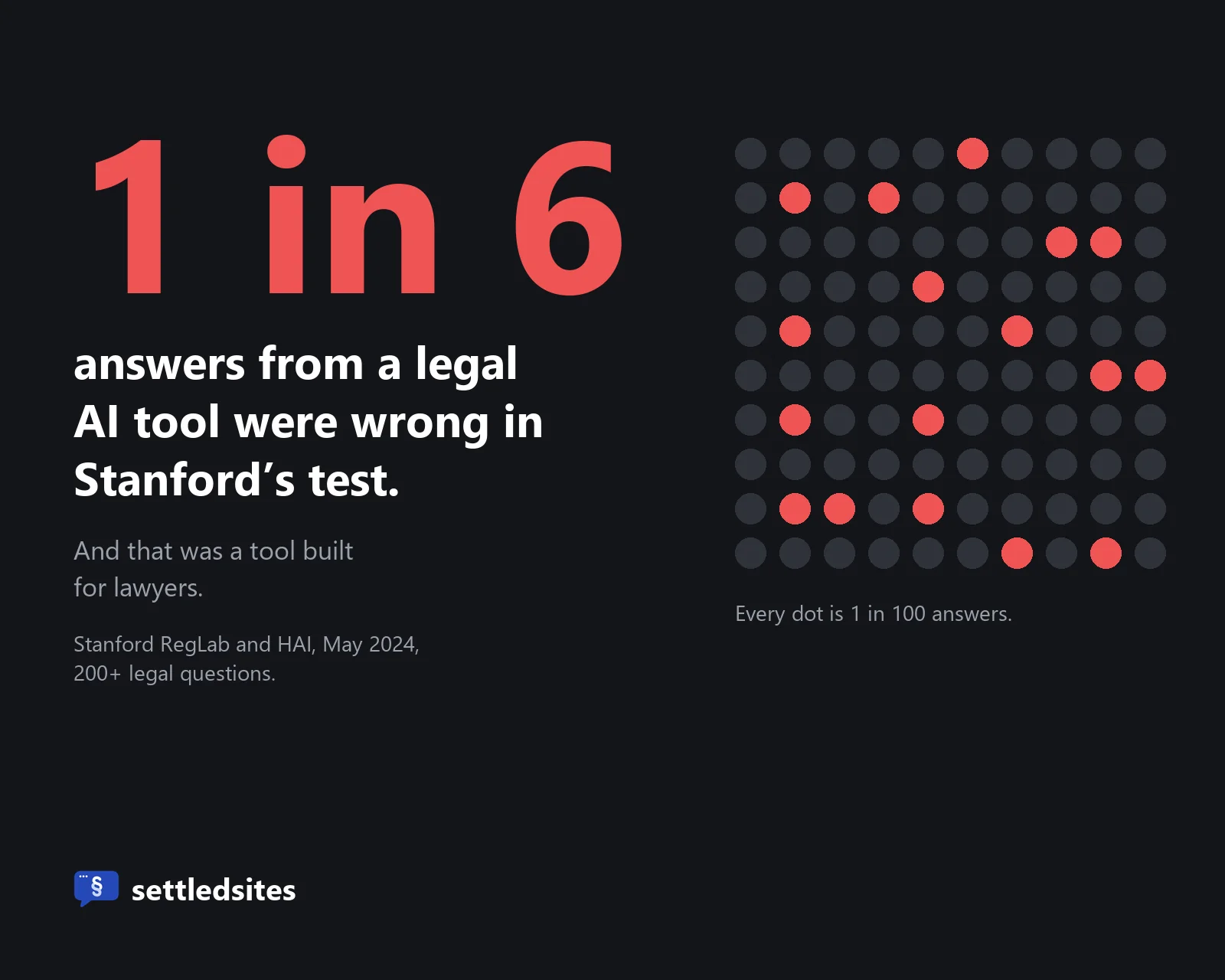
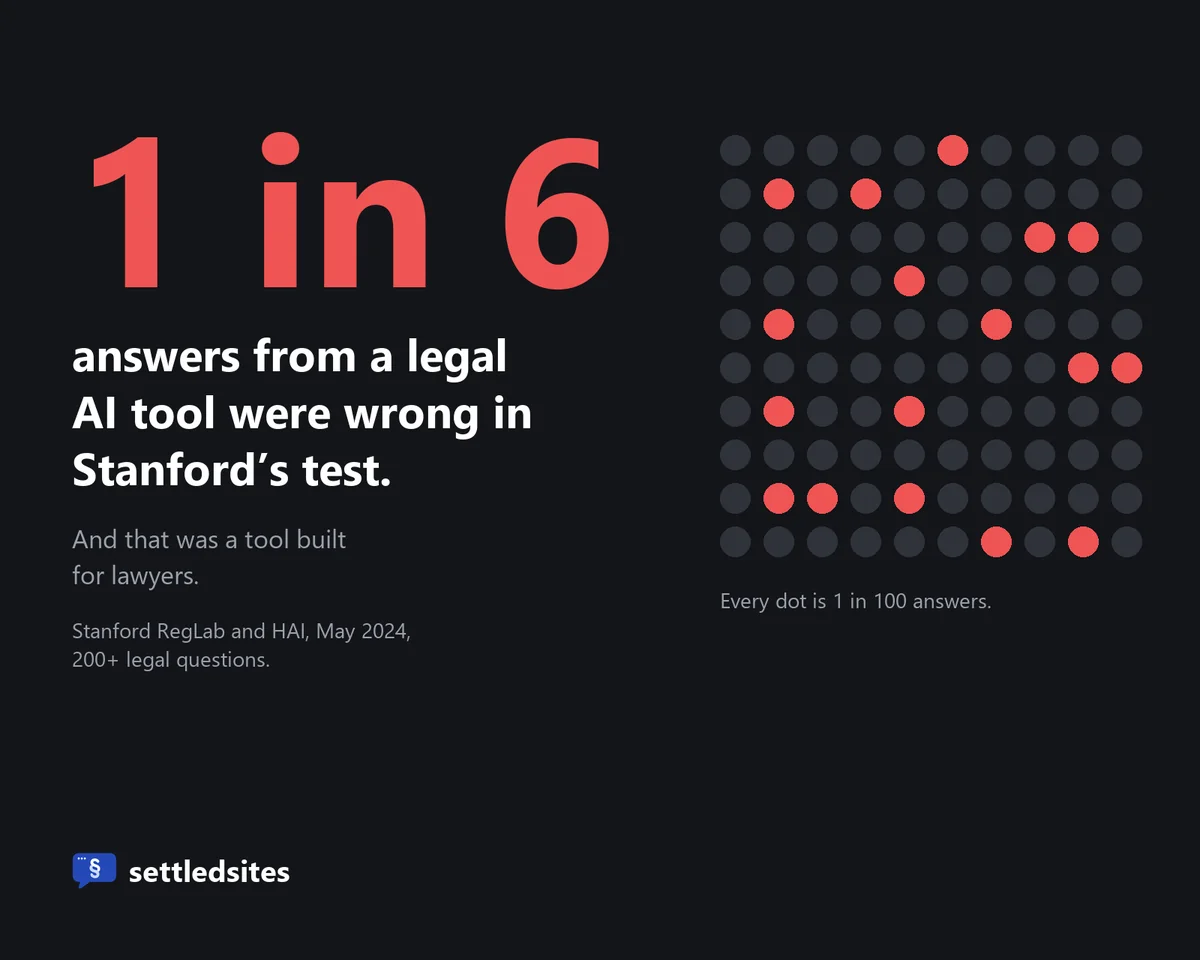
Over 1 in 6answers from legal AI research tools were wrong in Stanford's 2024 testStanford RegLab and HAI, 2024
86%of articles ranking on Google are written by humans (general web)Graphite, an SEO and content company, 2025
Who should write a law firm's website content?
Let me raise my hand right now and say that AI is not the devil. I'm writing these posts, and I'm using AI. Not for every word, and not for every idea. I use it to connect my thoughts and round off some of the rough edges. And it fixes my spelling and grammar like a boss.
I also think AI's strongest feature is its ability to analyze large amounts of data quickly, which is huge for research. Every number in these posts came from a source someone actually opened and checked. I set up my AI to stay well within what's true and verified. No guessing allowed here.
But I didn't just sit down and type in a prompt. I've trained my AI to work with me, with certain rules and a certain style, and that takes time. If you just plop down and tell it to write something, you'll get a dry, dense passage. Every post here gets worked and reworked until it says exactly what I want to say, the way I want to say it.
For me, a hybrid works. Plenty of great writers still do it 100% by hand.
But leaving the writing 100% up to AI is not the way to go. Ask a chatbot for a law firm homepage paragraph and see if it's memorable, or leaves even the slightest impression. To me it doesn't.
Some lawyers we read on Reddit land in the same place. The most upvoted comment we found on content: "Don't answer questions that builds someone else's website for them. Put those answers on your website." And on cheap content packages: "$199 for content means they're not writing it. It'll be AI generated." In one BBB complaint we read, a firm said nearly all of its vendor's blog posts were AI-written, and the firm's Search Console showed zero pages in Google. The vendor's public reply says it issued a refund of $2,428.39 on May 6, 2025.
Can lawyers use AI to write website content?
Here's what the bars, courts and vendors that have weighed in say. All of them put the checking on you:
- The Florida Bar (Opinion 24-1, 2024): "a lawyer must verify the accuracy and sufficiency of all research performed by generative AI." Chatbots on a website have to follow advertising rules and tell people they're talking to AI.
- The Illinois Supreme Court (AI policy for court filings, December 2024): lawyers "are accountable for their final work product."
- The ABA (Formal Opinion 512, July 2024): its first opinion on generative AI, built on a lawyer's duties of competence, confidentiality, communication and fair fees.
- Even a website vendor: LawLytics' own terms require "Human Review" of AI-written content by a licensed attorney.
How often does AI get the law wrong?
Often enough to matter. Stanford tested the AI research tools built for lawyers in 2024. Lexis+ AI gave wrong answers more than 17% of the time, and Westlaw's more than 34%. General chatbots did worse in an earlier study: 58% to 82%.
How often AI got legal questions wrong:
- General chatbots (earlier study): 58% to 82%
- Westlaw AI-Assisted Research: over 34%
- Lexis+ AI: over 17%
Source: Stanford RegLab and HAI, May 2024, more than 200 legal questions.
We ran our own test at DispuPoint, my other company, which helps Illinois homeowners with HOA and condo disputes. We asked ChatGPT, Gemini and Claude the same three Illinois condo questions, one at a time, the way a real homeowner would. ChatGPT gave an outdated deadline for a records request and twice referred to "a previous conversation" that never happened. Gemini overstated what an owner's hearing rights include. Claude did best, and still flagged a number it wasn't sure of. None of the three answers was safe to act on without checking the statute.
Courts are seeing the same thing. A public database now logs 2,266 court cases worldwide where AI made something up, 898 of them involving lawyers.
The most famous is Mata v. Avianca in 2023, where lawyers were fined $5,000 for fake ChatGPT citations. Even there, the judge wrote that "there is nothing inherently improper about using a reliable artificial intelligence tool for assistance." The problem was nobody checked.
Does Google penalize AI-written content?
Not for being AI. Google judges quality, not who typed it. In its own words: "Using AI doesn't give content any special gains. It's just content." What Google does punish is pages made mainly to game search, including "using generative AI tools or other similar tools to generate many pages without adding value for users." After its March 2024 update, Google says it cut low-quality, unoriginal results by 45%.
The results lean human anyway. Graphite, an SEO and content company, looked at 31,493 searches in 2025 and found 86% of the articles ranking on Google were written by people, and only 7% of the number-one results were AI-generated.
What does a good writing process look like?
Well, if you've read this far, it looks like what I'm doing right now.
Who writes, who checks:
- You supply the facts, the stories and the opinions.
- A writer or AI drafts and organizes it in your voice.
- You check the law, every claim, results and disclaimers against your state's rules.
- Publish, and update it when the facts change.
I can do this for you too. But I can't just rattle off blog posts. It takes some back-and-forth between us to produce content that works for you. A very simplified version of this would look like: you tell me what clients actually ask you, I turn it into pages, and you check every word before it goes live. That's how it should be.
If you're starting from zero, you're not alone: 6 in 10 Illinois firm homepages don't even link to a blog or articles section.
Want help writing your site the right way? You bring what you know. We turn it into pages people and Google can find, and you approve every word.
Questions lawyers ask about AI and website content
Will big firms beat me by churning out thousands of AI pages?
Probably not. Google treats mass-produced pages as spam (more above), so a few good pages that answer real client questions hold up fine.
Do I have to tell people AI helped write my website?
For a chatbot that talks to visitors, Florida says yes, and others may follow. For ordinary website pages, we haven't checked every state, so ask your state bar. Google suggests saying so where readers would expect to know. Either way, you're responsible for every word, so check it as if you wrote it yourself.
Does paying a blog writer help my rankings?
Only if the writer works from what you know. Google rewards helpful pages with real experience behind them, whoever types them. A writer who interviews you and gets the details right can help a lot. A $199 package of generic posts usually won't, and can put claims on your site you never approved.
What should I write about?
The questions clients ask you every week. Each one can be its own page: what happens at the first meeting, how long a case takes, what it costs. Answer them on your own site rather than on a directory's question-and-answer board, so the answer builds your website, not theirs.
How do I get ChatGPT to mention my firm?
Graphite found 82% of the articles ChatGPT and Perplexity cite are written by people, so real, specific content helps there too. The rest is in our post on getting recommended by ChatGPT.
Sources
- The Florida Bar, Ethics Opinion 24-1
- Illinois Supreme Court, Policy on Artificial Intelligence
- Stanford HAI, legal AI benchmarking, May 2024
- AI Hallucination Cases database (Damien Charlotin)
- Mata v. Avianca, Inc., No. 22-cv-1461 (PKC) (S.D.N.Y. June 22, 2023), Opinion and Order on Sanctions (copy hosted by the U.S. District Court for the District of New Hampshire)
- ABA Formal Opinion 512, Generative Artificial Intelligence Tools (July 29, 2024)
- Google Search Central on AI content and spam policies
- Graphite, AI content in search, October 2025
- Google, March 2024 search update and creating helpful content
- LawLytics, terms of service
- BBB complaint about a law firm marketing vendor, May 2, 2025
- SettledSites check of 5,101 Illinois law firm homepages, September to November 2026
- Reddit comments in r/LawFirm, 2024 to 2025 (linked in the text)
- DispuPoint AI variance test, July 2026
Written by Gaston Sitbon and Mark Jarvis, co-founders of SettledSites, with help from Claude, Anthropic's AI. Facts checked November 5, 2026.
Keep reading
See your own firm's new homepage before you pay anything.