Monthly fee or one-time build: which law firm website costs less?
One big payment or 36 small ones. The total isn't the whole story.

By Gaston Sitbon, co-founder of SettledSites
Published · Last reviewed
Short answer: Over three years, a one-time build plus cheap hosting usually costs less than a monthly website plan: about $3,544, against $10,800 for a $300-a-month vendor site. But the cheapest option on paper often isn't the cheapest in real life, because the real cost is your time, your site's security, and the calls you miss when something breaks. A monthly plan is worth it when it's month to month, real work gets done, and you own the site.
Lawyers ask us this on almost every call: why pay a build fee when you could just pay monthly? Here's the three-year math with real prices, and the costs that never show up on an invoice.
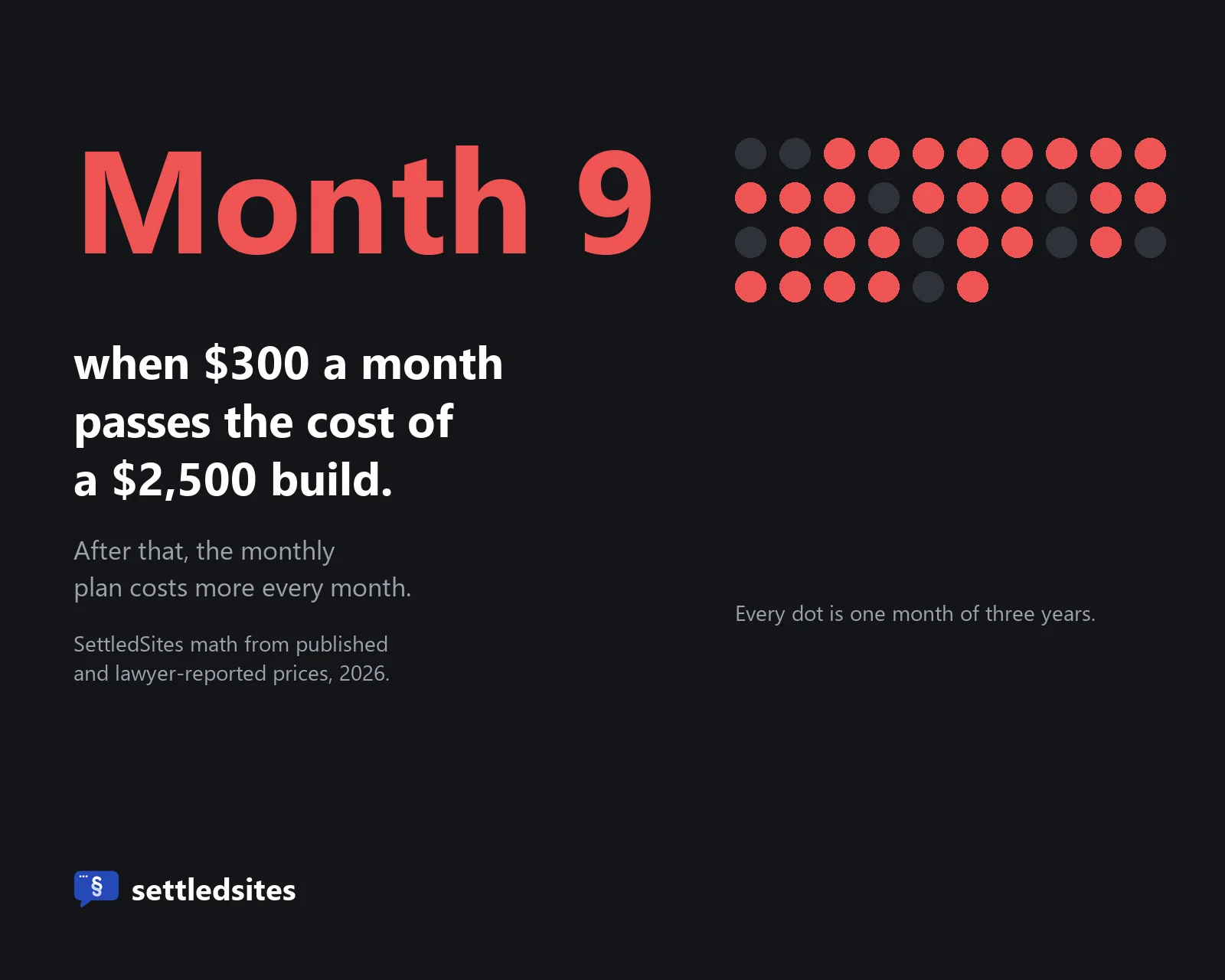
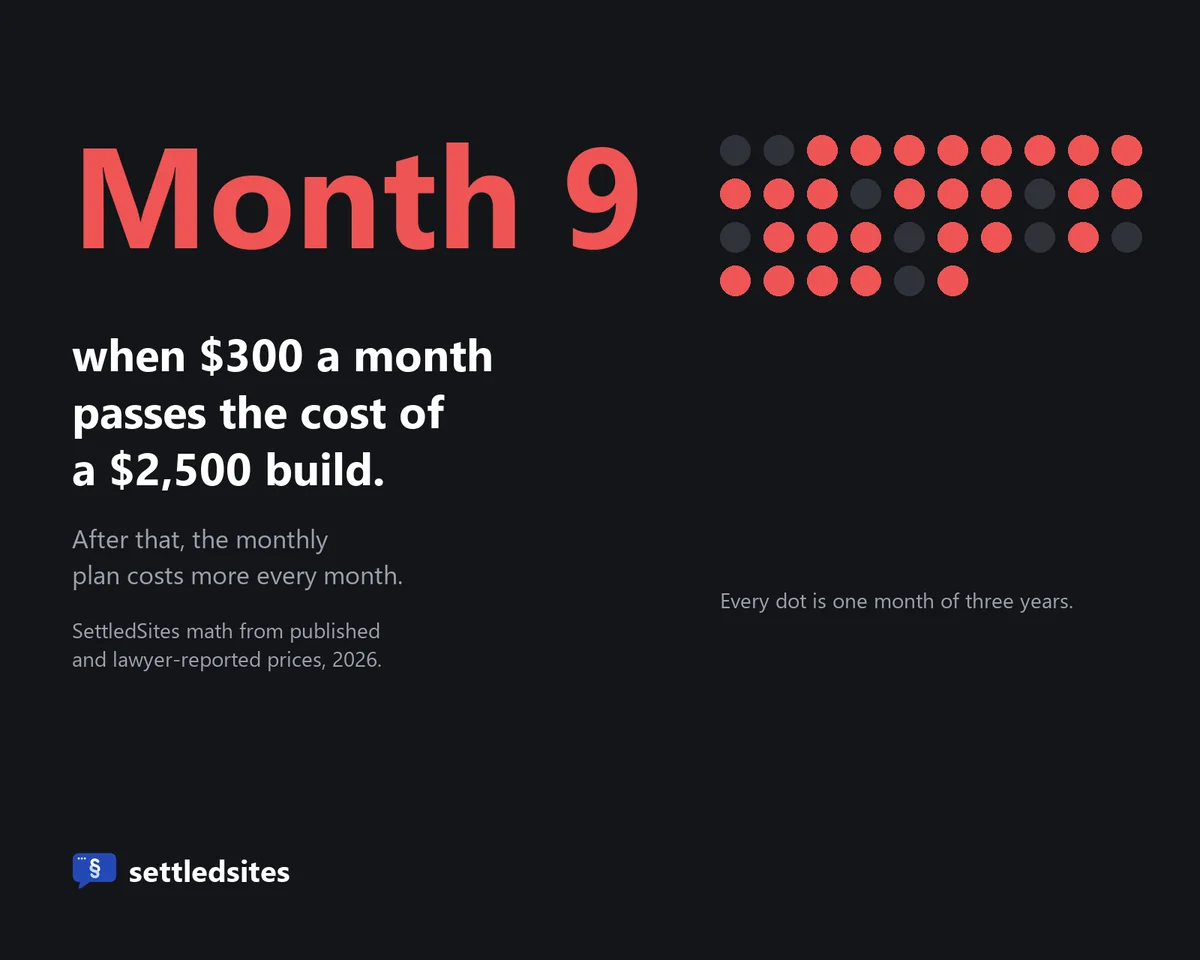
Month 9After 9 monthly payments, a $300-a-month plan has cost you more than a $2,500 buildLawyer-reported prices
$10,800three years of a $300-a-month vendor site, against $3,544 for a build plus hostingPublished and reported prices, November 2026
48%of law firms couldn't be reached by phone, even after callbacksClio, 2024
Which costs less: a monthly website plan or a one-time build?
On paper, the one-time build wins. Over three years, a $2,500 build on Squarespace costs about $3,544, roughly the same as the cheapest month-to-month legal platform and about a third of a $300-a-month vendor site. Keep in mind this is a baseline. There are add-ons we aren't counting, and some vendors won't tell us their prices at all.
- Squarespace, DIY: $1,044, plus your time
- $2,500 build plus Squarespace: $3,544, plus your time
- LawLytics Starter, $99 a month: $3,564, plus your time
- Vendor site, $300 a month: $10,800
- Vendor site, $500 a month: $18,000
What each option costs over three years. Build plus Squarespace Core hosting at $29 a month; DIY is Squarespace Core alone. Prices read November 5, 2026. Our own prices are on the pricing page.
But at this point, what you really need to put a price on is time. The time to learn the software. The time to write a solid page. The time to keep information current. Or the time to find a team that can fix what the last design studio built for you.
Say you have a few spare hours a day, roll up your sleeves, build it yourself and keep it up. Then your caseload grows. Now you either give up your own time, let the site fall behind, or hire your nephew. The savings are gone, and teaching your nephew to do it your way takes time too, no matter how confident he is.
When does a monthly plan make sense?
Security alone can justify one. WordPress had 11,334 new security holes found in 2025, 91% of them in plugins. If your site has a contact form where people type in personal details, someone has to keep it locked down. How each platform handles this is in Wix vs Squarespace vs WordPress.
I learned this one the hard way. My first website, back in 2016, was a WordPress site for my coffee roasting business. One of the plugins I used quietly added a link to a Chinese watch manufacturer at the bottom of every page I published. I had no idea. Mark found it in 2020, while helping me rebuild the site. So for four years, my coffee company was sending visitors to a watch factory. Nothing broke, nothing looked wrong, and nobody told me. That's the kind of problem you only catch if someone is actually looking. I was lucky it was only watches!
Then there are updates. How often does your firm change? A new attorney, a new phone number, a new practice area, a price change, a new rule from your state bar. Do you really want to log in and make every change yourself?
And things break. Like a car, a website needs upkeep. It isn't wear and tear, it's software updates, and your site may fall behind. You're busy fixing other people's problems, so when the contact form stops working, the only way you'll find out is if someone cares enough to call and tell you. That's if they have the right number, because yours changed in 2022.
One big thing, though. Make sure the site you rest your practice on is yours. Don't sign with a company that leases you a site and makes you start from scratch when you leave. That kind of plan is sticky paper, and you're the mouse. A legal marketer said it plainly on Reddit in February 2026: "When you stop paying, the website goes away."
So a monthly plan makes sense when it's month to month or has a short commitment, when real work happens every month, and when the site, the domain and the content are in your name. More in do you own your law firm website.
What does a missed call cost you?
More than any website plan. Plain and simple: if I'm looking for a lawyer and the site won't load or doesn't show a phone number, I'm back on Google looking for the next one, even if a friend referred me. I might try once more. But if I like what I hear from the next firm, guess where I'm going.
A website can't answer your phone. But it can show the right number, load fast on a phone, and send form messages somewhere you'll actually see them. The numbers on how many firms miss those calls, and what to do about it, are in how fast you need to call a new lead back.
Is your contact form actually reaching you? We'll test it, and your phone links, for free.
Can a lawyer be disciplined for what the website says?
Yes. It's rare, and it usually ends in a public reprimand, not a big fine. But the reprimand is public, and it shows up when clients search your name. Illinois Rule 7.1, for example, starts: "A lawyer shall not make a false or misleading communication about the lawyer or the lawyer's services." Three recent cases:
South Carolina, 2025. The site claimed "nearly 30 years" serving South Carolina clients when the firm had done South Carolina work only since 2018, and called its record of results "proof." The result: a public reprimand plus costs.
Florida, 2021. "Pitbull Lawyer" branding with a spiked-collar logo, only partly fixed after three notices from the Bar. The result: a public reprimand plus $1,331 in costs.
New Jersey, 2023. "LOWEST FEES IN THE STATE," plus "Our Attorneys" on a one-lawyer practice. The result: a reprimand plus costs.
That's why SettledSites checks every site against the advertising rules of the firm's own state before it goes live.
What should a monthly fee actually buy?
Hosting alone runs about $10 to $45 a month at regular prices. So if you're paying $300 or $500, ask for a written list of what happens each month: pages added, changes made, updates installed, reports sent. If the answer is mostly hosting and "maintenance," you're paying rent on a website.
Here's what we think a monthly fee should buy, and what ours does:
- A small team with a phone number you can actually call.
- Optional video calls with us twice a month.
- Changes done within one business day.
- Security updates, so you're not reading about the next hack and wondering.
- The peace of mind that the site is yours. If you leave, you take your whole site with you, with all the design work attached.
For the full checklist of what to ask before you sign, read the red flags to watch for when hiring a website company.
Whichever way you pay us, the site is always yours. Our prices are on the pricing page, in full.
Questions lawyers ask about monthly website fees
Is it a rip-off to pay $300 a month for a website?
Not if real work gets done every month and you own the site. Over three years, $300 a month adds up to $10,800, against about $3,544 for a $2,500 build plus Squarespace hosting.
What does a $500 a month plan include beyond hosting?
Many vendors won't say until you're on a sales call, so ask for the list in writing. Hosting alone runs about $10 to $45 a month, so the rest should buy work you can see: pages added, changes made, updates installed, reports sent.
Can I get disciplined for what my website vendor wrote?
The advertising rules are written for the lawyer, not the vendor. In the cases we found, from South Carolina, Florida and New Jersey, the result was a public reprimand plus costs. Have every claim on your site checked against your own state's rules.
Can I sue if the vendor promised more business?
That's a question for a lawyer who handles contract disputes, not for us. What we can say: if a promise matters to you, get it in the signed agreement before you pay.
Which is better for a new firm, monthly or one-time?
A new firm usually has more time than cash, so nothing up front can help you launch. Pick a plan with a short commitment where you own the site. Once the work picks up and your time gets tight, a build fee with a lower monthly price usually costs less over the long run.
Sources
- Squarespace, LawLytics and B12 pricing pages, read November 5, 2026
- SiteGround WordPress hosting and Bluehost WordPress hosting, regular (non-promo) prices, read November 5, 2026
- Clio (a legal software company), 2024 client intake secret-shopper study, 500 law firms
- Patchstack (a WordPress security company), State of WordPress Security in 2026
- In re Hostilo, S.C. Op. No. 28272 (April 9, 2025)
- The Florida Bar v. Pelletier, No. SC21-316 (2021)
- In re Walkow, N.J. DRB 23-062 (2023)
- ABA Model Rules of Professional Conduct
- Illinois Rule of Professional Conduct 7.1
- Legal marketer's comment in r/LawFirm, February 23, 2026
Written by Gaston Sitbon and Mark Jarvis, co-founders of SettledSites. Facts checked November 5, 2026.
Keep reading
See your own firm's new homepage before you pay anything.